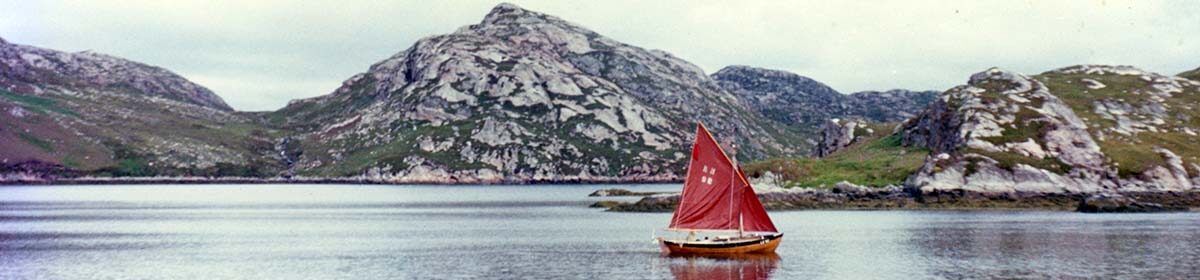
My uncle went to sea in a boat with a calico skin… is the opening sentence of the story of The Voyage of The Aegre. He really did. He was a key organiser and a participant in the 1963 re-enactment of St Columba’s 563 AD curragh voyage from the north of Ireland to Iona, off the west coast of Scotland.
In Iona St. Columba founded a monastery that became a centre of the Christian world for hundreds of years. Today more than 130,000 pilgrims visit Iona every year in his memory.

The book about the curragh voyage re-enactment
My Uncle Jack (John Barry) wrote a small book about the curragh voyage re-enactment in 1964, calling it ‘Joyful Pilgrimage’.

As Jack’s 13-year-old nephew, living far away in England, I followed this grand adventure with envy. But then his book brought the fun of it all to life and must have lodged somewhere in my brain, for ten years later, Julie and I sailed away aboard The Aegre. Jack was now following us over every wave.
Jack frequently entreated me to write the story of The Aegre, but sadly didn’t live to see it, dying in 2006, seven years before it was published.
Meanwhile, Joyful Pilgrimage had been out of print for sixty years.
Publishing a Facsimile Edition
Feeling both a debt to Jack and a desire to share his story and something of the inspiration of St. Columba, I got together with my Aegre book publishing colleagues, Gene Carl Feldman in Washington and David Burnett in Ludlow, to explore publishing a facsimile edition of Jack’s 1964 book. Jack’s eldest son Jonathan (16 at the time of the voyage) gave his support and we got to work.
Published in late October 2025, Joyful Pilgrimage – In the wake of St. Columba by John Barry, is a facsimile edition of the 1964 book, enlarged and with a Preface by John Barry’s son, Jonathan.
.

In Joyful Pilgrimage, John Barry, the instigator of it all, tells the story with the dry humour of an Ulsterman, savouring the outlandish original idea and how it was shaped, aided by a growing band of supporters, into a grand adventure of faith and fraternity. Barry writes in a self-deprecating way, claiming expertise in nothing. For him, the heroes are the skipper, Wallace Clark, an eminent Irish yachtsman of the time; the curragh designer, Richard MacCullagh; the boat builder, Jim Boyd of Donegal; the other crew members; and the curragh itself. But beneath Barry’s commentary, his own engaging and passionate influence shines.

It was a remarkable adventure long before re-enactment voyages became popular.

The book will interest modern-day pilgrims who wish to learn more about St Columba and his historic decision to leave Ireland for Scotland, as well as the course he and his followers took. But more than that, for those interested in ancient craft and the sea, the skipper, Wallace Clark, reflects on the decision to build a curragh. He tells us about the design, building, and her sailing performance, and reflects on how the vessel might have been improved with hindsight.
The book is illustrated with drawings and photos.
About the author
John Barry was born in Belfast in 1915 into a Protestant family, the descendants of religious migrants from Northern Italy who had reached Ireland in the early 17th Century. Embodying the spirit of his forbears, he was ordained in 1938, coming to believe that in life we may be called to travel and must be ready to embrace others and their differences, their cultures and ideas.
In St Columba, he found a kindred spirit, someone from the distant past whose spirituality predates our contemporary divisions and whose vision can inspire us in the present and lead to a better future.
Where can you find the book?
This new facsimile edition of Joyful Pilgrimage is available in UK bookstores and on Amazon.
More about St Columba, curraghs and the re-enactment voyage
Learn more about St Columba and the 1963 re-enactment of the curragh voyage.
A 25-minute film about the voyage, narrated by Wallace Clark, is available on YouTube. Do watch it; it’s quite something.
Gene Feldman, my co-researcher for this website, recently found another video on YouTube about St Columba. The second half of the video, starting at approximately 19 minutes, is about the 1963 currach voyage.
Richard McCullagh, the designer of the curragh, subsequently published The Irish Currach Folk: Life on the Western Seaboard from Galicia to Greenland (Wolfhound Press, 1992).

It’s a beautiful book. It’s expensive to buy new, but ABE Books usually has a few used copies at a reasonable price.
To learn a lot more about Irish curraghs and St. Columba see this YouTube video by Donal Mac Polin.
Dónal was the assistant editor and art editor of Traditional Boats of Ireland: History, Folklore and Construction, which was edited by Críostóir Mac Cárthaigh. Dónal is also the author of The Drontheim: Forgotten Sailing Boat of the North Irish Coast and of The Donegal Currachs.
2023 Reunion of crew members
In June 2023, four of the original crew members gathered in Bunbeg to celebrate 60 years since the momentous voyage, while also remembering the nine other crew members who had sadly passed away since the trip. Billy Paterson and curragh builder Jim Boyd met up with Alistair Jameson and John Connolly for the occasion. The Donegal News carried the full story with photos.
A member of the crew, Billy Paterson, spoke to the Donegal News
More about curraghs
Following the posting of the above currach story, an old friend of mine from the NZ Outward Bound School, Ian Shapcott, wrote to me about his 94-year-old neighbour in NZ, Alan Byde. In his day in the UK, Byde was a world kayaking guru, writing the seminal book ‘Living Canoeing’ back in the late 1960s. But he also knew quite a bit about curraghs and wrote about them in the very first edition of ‘Afloat’ magazine. This has been reproduced on the kayakarchy website. Well worth a look.